
Claude Max, third-party harnesses and the extra credit offer: why developers are angry
Mike Codeur
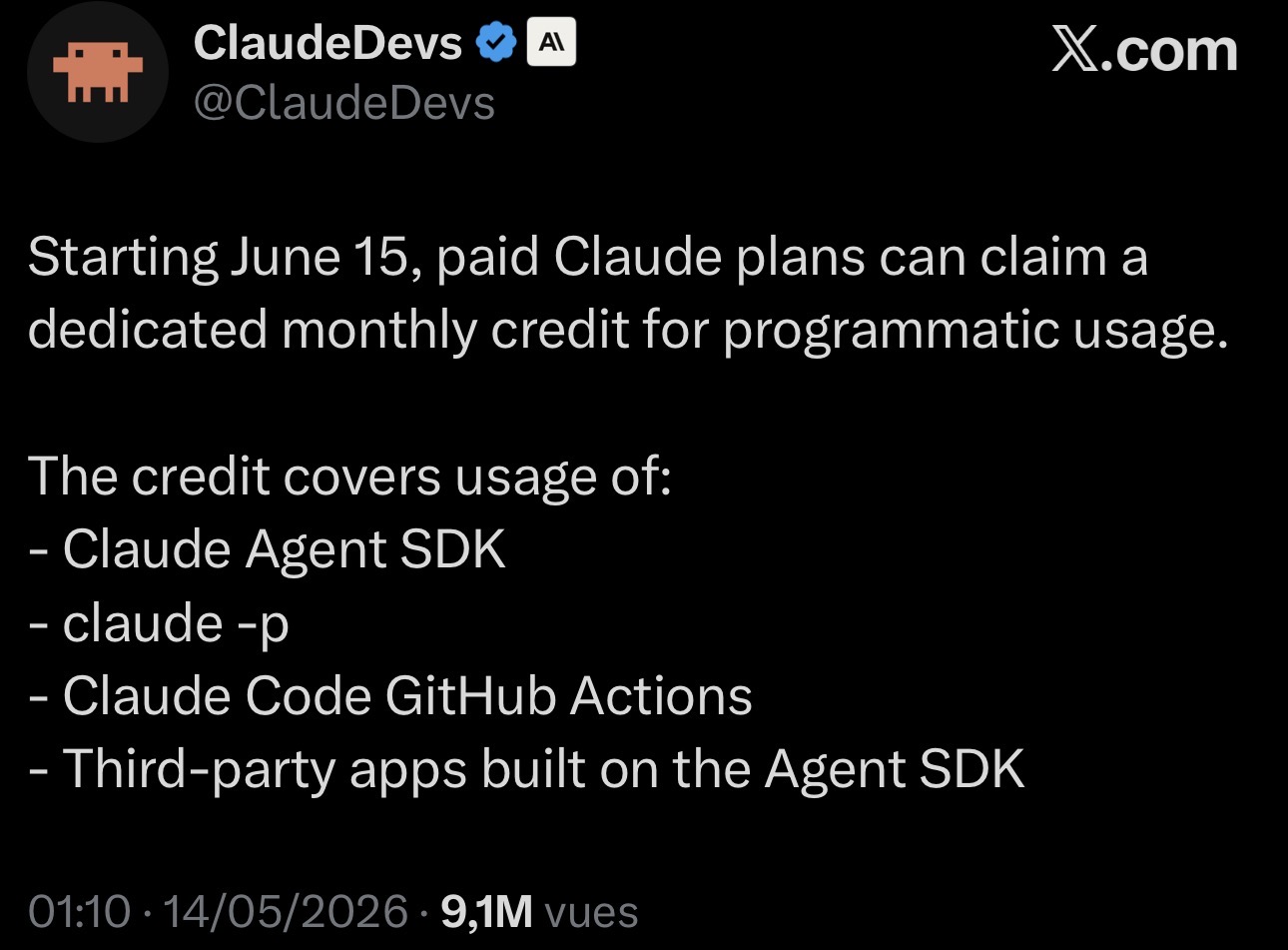
Anthropic just announced an important change for paid Claude plans: starting June 15, some programmatic usage moves into a dedicated monthly credit.
On paper, it looks like a bonus. In practice, for developers building harnesses around Claude Code, it is a change in the contract.
What does not change for most users
If you use Claude Code interactively in your terminal or IDE, you are probably not directly affected.
You can keep using Claude Code to discuss with the agent, edit code, review changes and iterate normally.
The real issue is programmatic usage:
- Claude Agent SDK
claude -p- Claude Code GitHub Actions
- third-party apps built on the Agent SDK
- third-party harnesses like OpenClaw, Conductor or Hermes
That is where the decision becomes much more sensitive.
Act 1: third-party harnesses on subscriptions
At first, some tools used Claude Pro or Max subscriptions to run agents through unofficial paths.
Anthropic's technical complaint was understandable:
| Point | Problem |
|---|---|
| Cache | poor prompt-cache reuse |
| Context | long and repeated requests |
| Cost | inference too expensive for a flat subscription |
| Product | usage outside Anthropic's intended interfaces |
If a tool multiplies inference cost because of poor cache management, Anthropic will not subsidize that forever inside a $100 or $200 subscription.
Act 2: OpenClaw plays by the rules
The logical move was to go through Claude Code CLI.
That is what OpenClaw did: use Claude Code as the engine instead of calling the API directly with fragile context handling.
The harness idea is simple:
- Claude Code remains the official engine.
- The harness adds orchestration.
- Context is structured better.
- Cache behavior is cleaner.
- Developers can build a real agentic system around it.
At that point, Anthropic's technical justification seems respected.
Act 3: the extra credit offer
The new announcement changes the situation.
Anthropic does not say: "we are blocking third-party harnesses".
They present it as a dedicated monthly credit for programmatic usage.
But the consequence is clear:
- subscription usage no longer covers some programmatic scenarios
- third-party harnesses are pushed toward API billing
- credits are dedicated, limited and not shared
- Claude Max becomes much less attractive as the base of an Agentic OS
Why the cache argument is no longer enough
If the problem was only technical, tools that cleanly go through Claude Code CLI should be fine.
If they are also affected, then the real issue is commercial and strategic:
- protect Claude Code margins
- prevent third-party products from owning the agentic layer
- push heavy usage toward direct API billing
- keep control of the interface between developers and the model
Anthropic has the right to do that. But it should say it clearly.
The real risk: trust
The issue is not only price. It is trust.
You give developers a technical rule. They adapt their architecture. Then you change the rule and package the restriction as a benefit.
That is how an ecosystem loses confidence.
Developers can accept limits. They can accept higher prices. What they do not like is having the goalposts moved while being told it is a gift.
Conclusion
Anthropic is not blocking Claude Code for most users.
But for people building harnesses, Agentic OS workflows and automated systems around Claude Code, this is a turning point.
The question is no longer just how much Claude Max costs.
The real question is: who controls the agentic layer above Claude?
I break down the full story in the video: https://mkc.sh/claude-max?utm_source=blog
I also share this kind of analysis every week in The Agentic Dev: https://mkc.sh/the-agentic-dev?utm_source=blog