
OpenAI DevDay 2026: 15 announcements developers should sort through
Mike Codeur
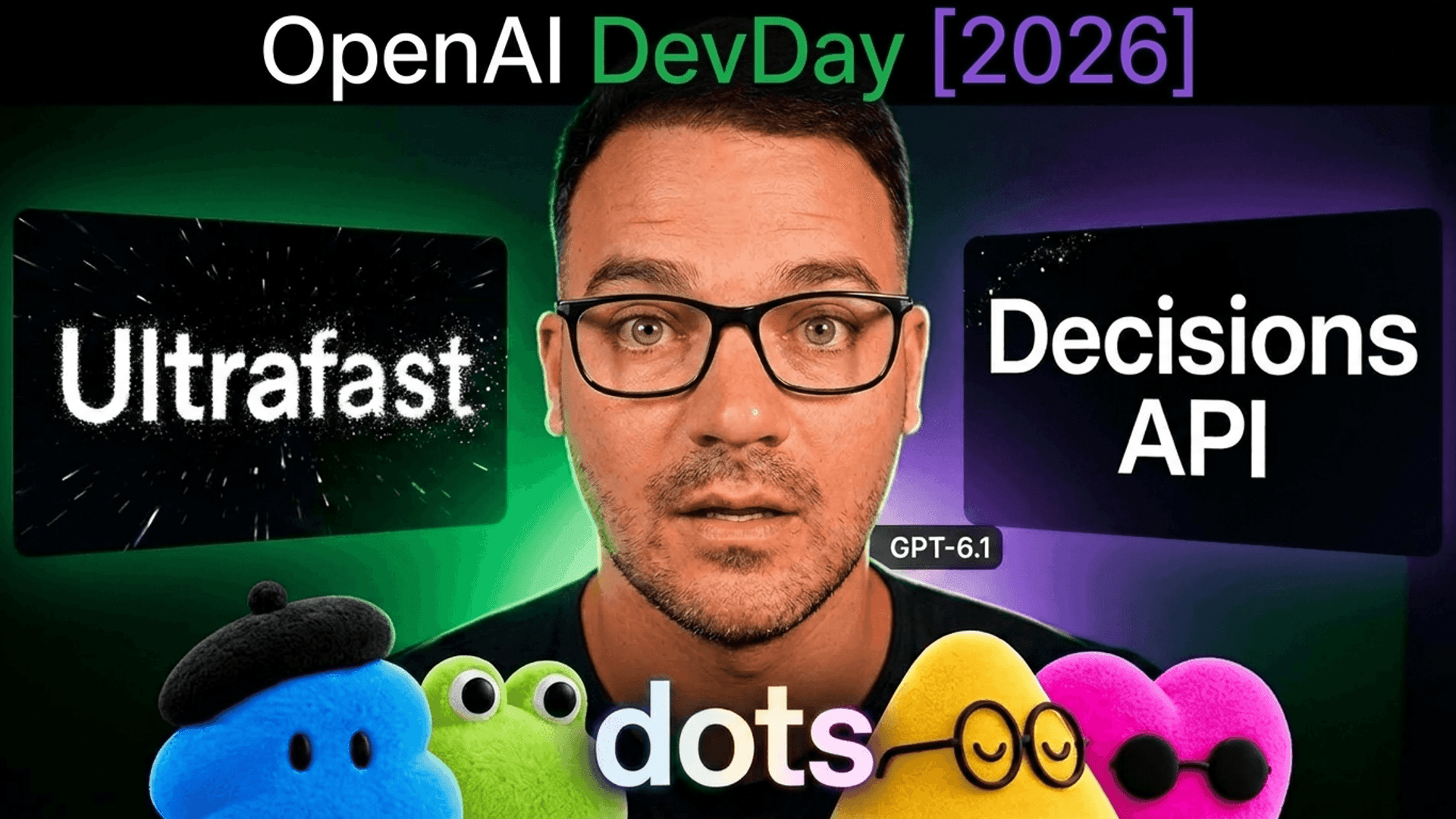
OpenAI announced more than twenty updates at DevDay on September 29, 2026. Mike picked fifteen relevant to developers. The useful question is not how many launches there were, but what a team can use today, what has limited access and what remains an announcement. This article follows the video and recording notes; it does not claim Mike personally tested all fifteen products.
Agents and models: what can they do?
Dots is presented as an always-on agent working across connected apps: it follows tasks and brings work back for approval. Announced access applies to eligible Pro and Business Premium users, with administrator-enabled beta access on certain other plans. A vendor demo is not the same thing as a reproducible test on your account.
GPT‑6.1 Sol targets agentic coding and computer-based tasks. OpenAI announced API and ChatGPT Work/Codex availability on eligible plans, but not yet in Chat. Ultrafast brings GPT‑6 Astra to Codex: the up-to-300-tokens-per-second figure is OpenAI’s claim, not Mike’s measurement. Sol Ultrafast was announced as upcoming.
Agents API with computer use lets an application give an agent tools, computer interaction and delegated subtasks. Its permissions and environment still need deliberate boundaries. Decisions API chooses among answers you define from text or image context, in a limited preview. For a product, keep bounded decision-making distinct from real actions and confirm access before integrating either.
Codex: execution, review and security
Codex cloud runs tasks in a preconfigured repository environment available from another device. Codex CLI adds the /agents view for parallel work, voice interaction and session resumption. In practice, the repository setup, permissions, diffs and recovery path decide whether this helps your team.
Code Review reviews diffs before comments go to a PR or MR; automatic cloud review is a separate workflow. Codex Security Cloud scans GitHub repositories, investigates alerts and proposes fixes for approval. Neither removes the need for tests or human review. Private Intelligence combines zero data retention with private security processing according to OpenAI; Private Inference was still announced as an upcoming preview. Do not read this as a blanket guarantee for every account.
ChatGPT as a working platform
Plugin extensions give plugins an interactive panel and files inside ChatGPT. MCP Events can trigger background work from an event in a connected application. ChatGPT Space shares team context. Interface, trigger and shared knowledge are separate jobs: identify the event, the action, the destination and how a teammate checks the result.
The video also covers the remaining announcements slide by slide with their access conditions. Plans and availability can change, so check official product pages before deployment. Mike has not personally tested every announced capability; the recap is a shortlist for evaluation, not a production certification.
A practical way to evaluate them
| Need | First check | Evidence to ask for |
|---|---|---|
| Build an agent | Agents API, access and permissions | One isolated task with human approval |
| Move code forward | Codex cloud/CLI and review | Reviewed diff, tests and resumed session |
| Automate in ChatGPT | Extension, MCP event and Space | Observable trigger and result shared with the team |
| Protect a repository | Security Cloud scope | Useful alert and reviewed, tested fix |
The video separates announcements from hands-on evidence. Before changing your workflow, write down the access tier and test one specific task.
Join The Agentic Dev for practical reports on AI agents and software development.