
Is this the end of Markdown?
Mike Codeur
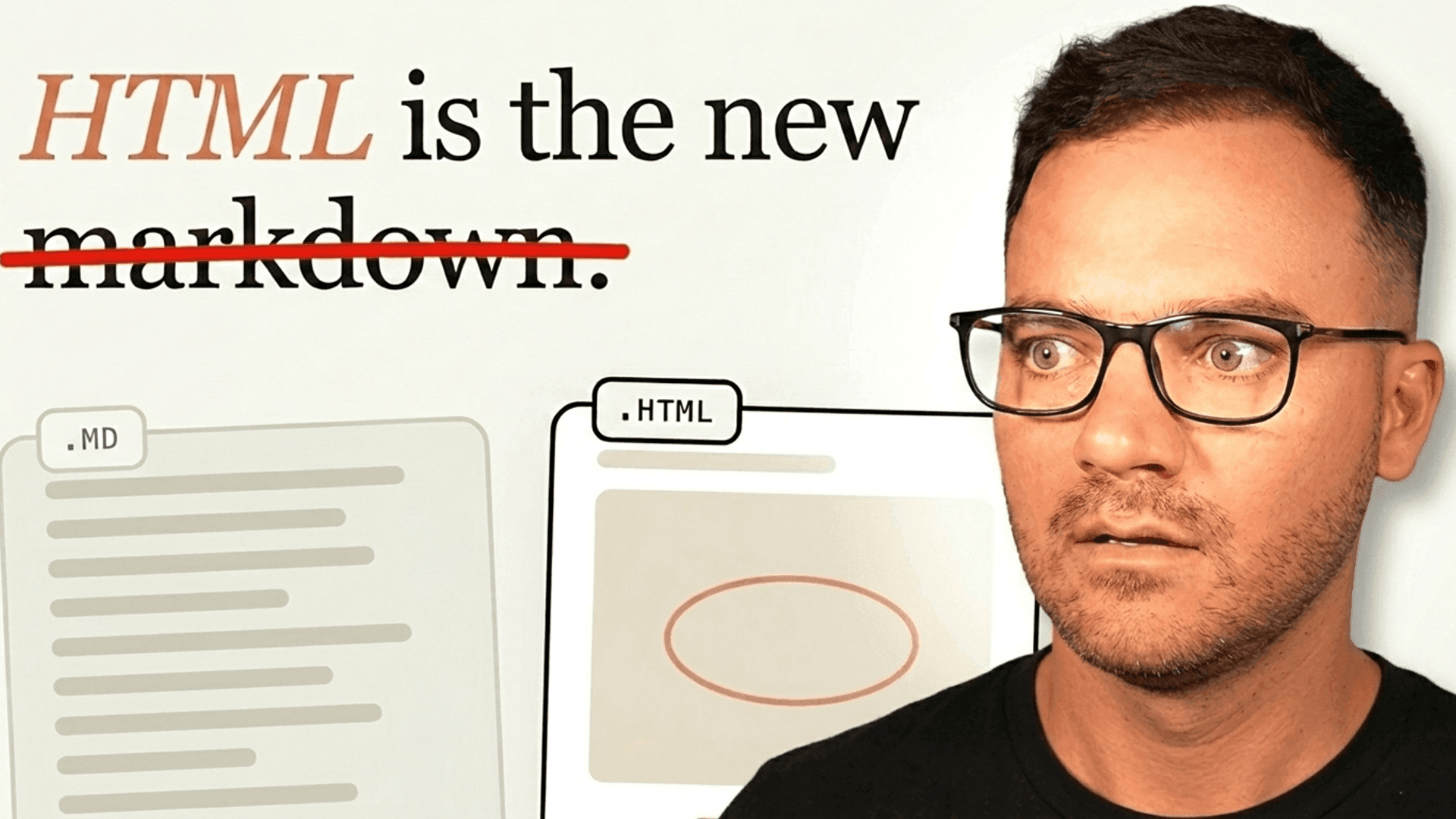
For years, Markdown has been the natural format for working with AI. It is simple, readable, easy to version, easy to paste into a prompt, and perfect for specs, notes, lightweight documentation and agent context.
But an interesting idea is coming from the Claude Code ecosystem at Anthropic: for some human-facing outputs, HTML can be more powerful than Markdown.
The nuance matters. Markdown is not dead. But it is not always the best format when the goal is no longer just to read text, but to understand, compare, manipulate or decide.
Why Markdown won with AI
Markdown works because it solves many practical problems for agents:
- it stays readable as plain text;
- it is easy to version with Git;
- it copy-pastes cleanly into prompts;
- it works well for specs, plans, summaries and notes;
- it is lightweight compared to more verbose formats.
For feeding an AI with context, Markdown is still excellent. If you want to give Claude Code a product spec, a README, a set of rules or a work plan, Markdown is probably still the right choice.
Where Markdown starts to break down
The problem appears when the agent is not only producing text anymore.
When you ask an AI to help you:
- compare several options;
- explore an architecture;
- understand a complex flow;
- prioritize tasks;
- visualize a code review;
- make a product decision;
- read a report with multiple layers of information.
In those situations, a long Markdown file can become heavy. You scroll. You read. You mentally rebuild the structure. And sometimes you stop before really using the output.
Why HTML becomes interesting
HTML lets the agent generate something beyond text: a mini-interface.
Not necessarily a full application. Often just a temporary file, opened in the browser, designed to help you understand or decide faster.
Concrete examples:
| Need | Markdown | HTML |
|---|---|---|
| Compare ideas | text list | visual cards side by side |
| Explore a concept | linear explanation | interactive diagram |
| Prioritize tasks | static table | movable columns |
| Read a code review | text blocks | structured file-by-file view |
| Present a report | long document | navigable dashboard |
This is not just about making things prettier. The real point is decision-making.
A well-generated interface can make information clearer, easier to manipulate and more actionable than a 200-line Markdown file.
The right mental model
The right conclusion is not "HTML replaces Markdown everywhere".
The better distinction is:
Markdown to feed the AI. HTML to feed the human.
Markdown remains excellent for inputs: context, specs, rules, documentation, memory and RAG.
HTML becomes interesting for some outputs: dashboards, visualizations, explorations, interactive reports, mini-tools and temporary deliverables.
Why this changes agentic workflows
The more AI agents produce, the more the output format matters.
If the agent generates 100 lines, Markdown is enough.
If it generates a deliverable you actually need to use, review, compare or manipulate, HTML can be much more appropriate.
This is an important shift in agentic workflows: we do not only ask AI to answer anymore. Sometimes we ask it to build a disposable interface that helps us think.
Watch the video
I explain the precise cases where HTML starts taking Markdown's place in this video: https://mkc.sh/html-markdown?utm_source=blog
And if you want more practical insights about Claude Code, AI agents and agentic development workflows, I share them in The Agentic Dev: https://mkc.sh/the-agentic-dev?utm_source=blog